
Genesee County Deed Records and What They Show
record details
| Deed Type | What It Does | Common Use |
|---|---|---|
| Warranty deed | record details | record details |
| Quitclaim deed | record details | record details |
| Grant / special warranty | record details | record details |
| Trustee / executor deed | record details | record details |
| Tax deed | record details | record details |
record details
The Genesee County Grantor-Grantee Index
record details
- record details
- record details
- record details
- record details
- Grantor
- record details
- Grantee
- record details
- Chain of title
- record details
- Book/Page vs Instrument #
- record details
Getting a Copy of a Genesee County Deed
record details
Recorded, not guaranteed. record details
Genesee County Deed Types
Genesee County deed records capture the instruments themselves, not just owner profiles. The recorded document type signals what happened. A bargain and sale deed, quitclaim deed, executor's deed, or corrective deed each serves a different purpose. Some transfer a full interest. Others clarify one. Still, the language inside the recorded image controls what the instrument actually does.
| Deed type | What it commonly does | Research use |
|---|---|---|
| Bargain and sale | Conveys the stated interest | Trace an ordinary transfer |
| Quitclaim | Releases the grantor's stated interest | Follow family or corrective changes |
| Fiduciary deed | Conveys under estate authority | Connect probate to land |
| Corrective deed | Repairs a stated defect | Compare with the prior instrument |
SearchIQS Coverage for Genesee Deeds
Genesee County deed records on SearchIQS split into two eras. The indexed images with modern instrument results run from 1984 forward. Before that, deed index books cover 1802 through 1983. Deed record-book images span 1881 through 1984. That overlap matters. It means tracing an older parcel often calls for a move from a party index into a cited volume, page by page.
The SearchIQS Genesee coverage table appears in the image below.
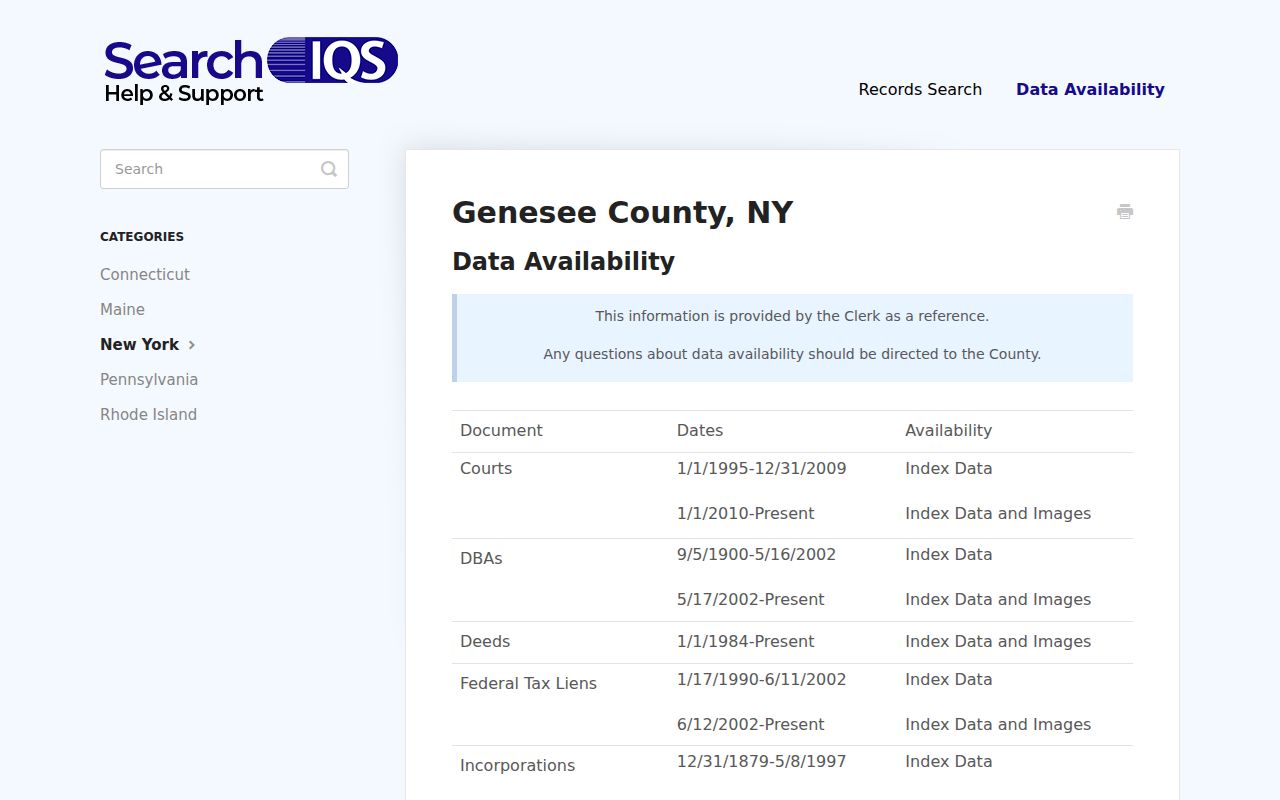
Confirm details on the live help page before planning a deep deed search.
Grantor-Grantee Chain Steps
Every deed names two sides. The grantor conveys the interest; the grantee receives it. Start from a current deed you already trust. Copy down its grantor, grantee, date, document type, book and page or instrument number, and the full legal description. To walk the chain backward, search that deed's grantor as a grantee in an earlier deed, then repeat the same steps.
- Confirm the current parcel and owner clue in the roll.
- Open the latest deed and read its full legal description.
- Search the grantor's earlier acquisition.
- Match town, acreage, lot, and prior deed references.
- Continue into index books when the modern range ends.
A tidy chain breaks easily. Names shift through variants, initials, married names, estates, and corporate owners, so search broadly enough to catch them all. Accept a link only when the land description itself supports it.
SearchIQS Deed Search Fields
SearchIQS lets you work a Genesee County deed records search several ways. Party and name lookup fits a chain of title. Book and page wins when PROS or an older deed hands you a citation. Date and document filters trim a crowded result set.
| Field | Use | Caution |
|---|---|---|
| Party name | Grantor or grantee trail | Try name variants |
| Date range | Narrow likely transfer years | Recording follows execution |
| Document type | Separate deeds from other instruments | Do not omit corrective deeds |
| Book/page | Open a known citation | Confirm county and record series |
Official Genesee Deed Access
The County Clerk serves as keeper of real-property records for Genesee County. The office points researchers to SearchIQS for online deed research. The SearchIQS portal handles index searches freely. Some image functions may require an account or subscription choice. Genesee County deed records that resist the web route still yield at the clerk counter. Staff there can produce a certified copy. They can also resolve an unreadable image or pull an older book from the shelves.
The official Genesee SearchIQS login is the page visitors reach to begin a search.
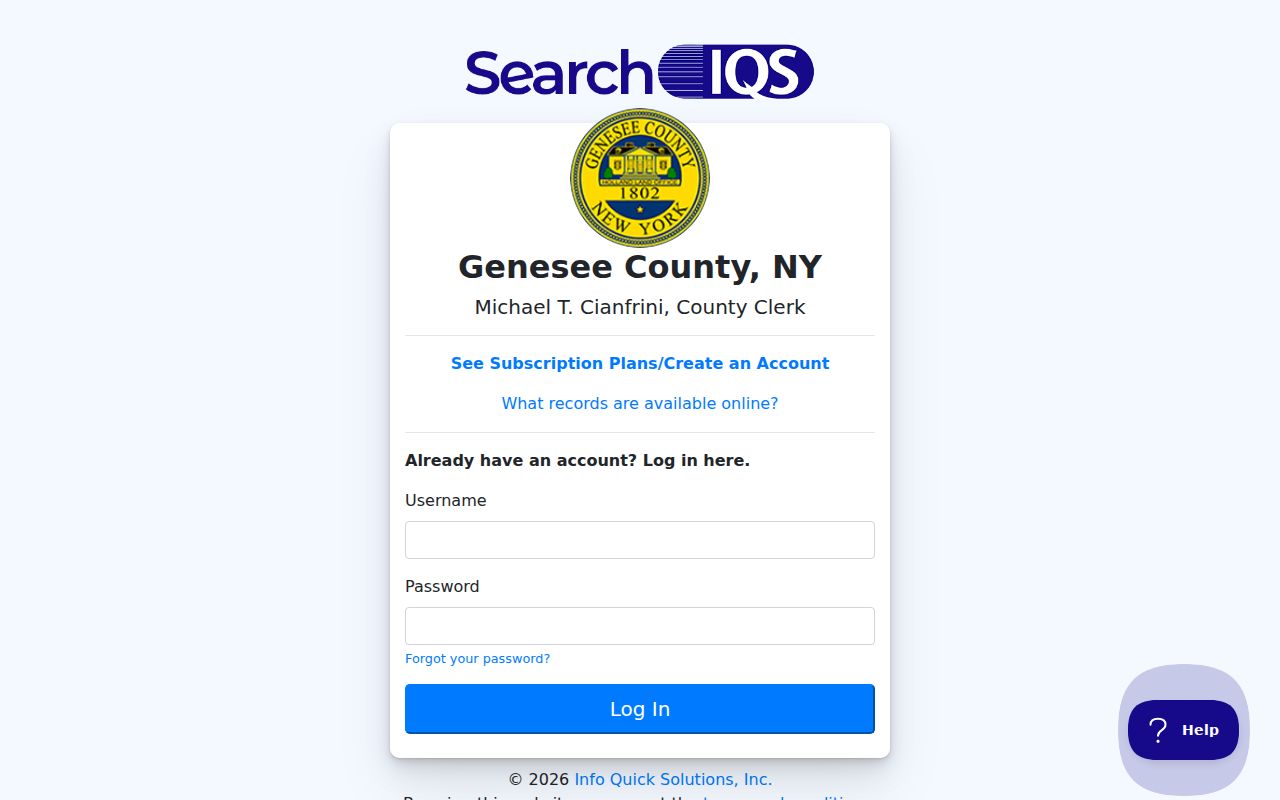
The login screen itself governs current sign-in terms and access rules for Genesee County deed research.
Genesee Deed Filing Rules
The County Clerk publishes deed guidelines covering the full filing package. That includes RP-5217 and TP-584 material, transfer-tax questions, recording charges, and paper requirements for Genesee County filings. Anyone ordering a copy should keep copy access separate from recording requirements. The two services follow different rules. Ask the Clerk which service fits the task. The current fee schedule settles any charge questions before you commit.
The official deed-guidelines page spells out these filing rules for Genesee County.
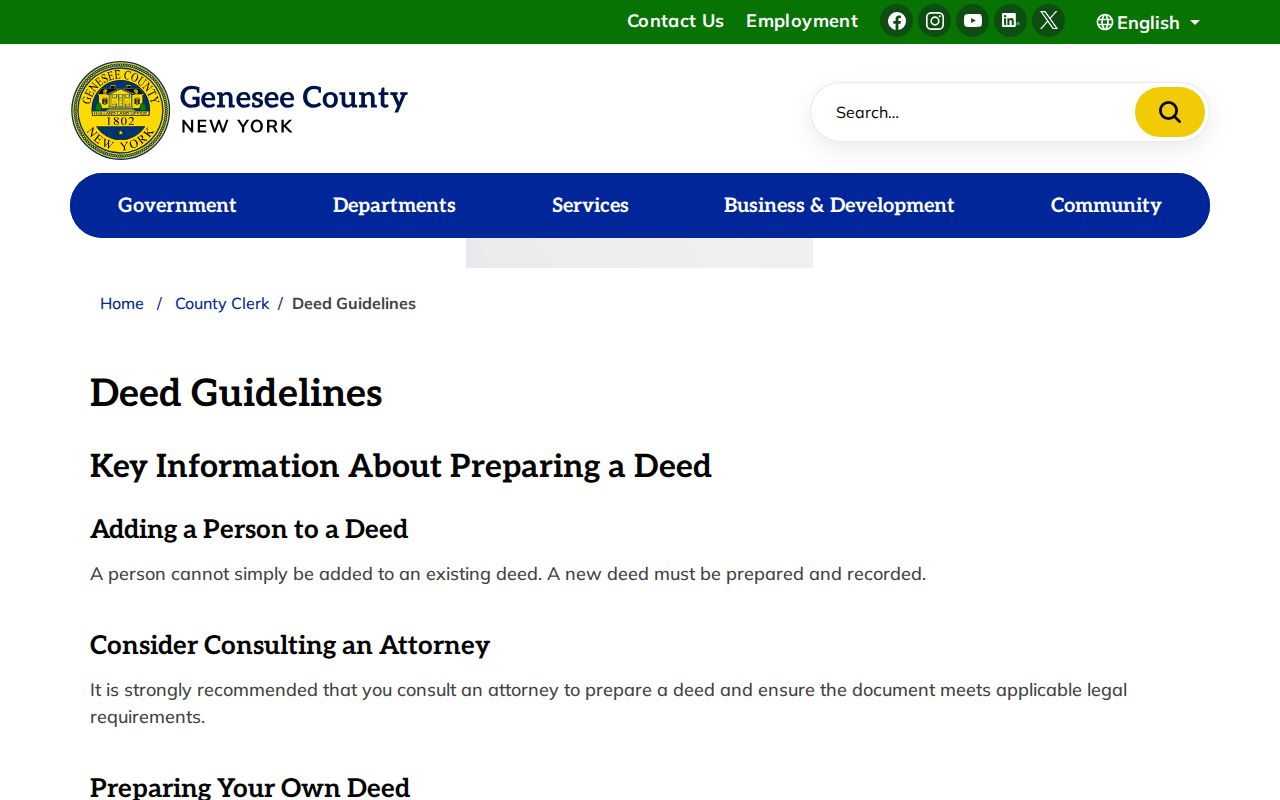
Use the current page and fee schedule before submitting or paying for a document.
Maps and Legal Descriptions
A street address is only a clue. The lot, tract, or metes-and-bounds description in the deed defines the land. Check the deed's subdivision, map, and prior-instrument references against the SBL and the recorded plat. A tax-map outline can orient the search. It never overrides the recorded deed.
- Book and page
- A volume citation used to retrieve a recorded document.
- Instrument number
- A unique recording identifier in a modern index.
- Chain of title
- The sequence of recorded transfers affecting the same land.
- Legal description
- The deed language identifying the conveyed premises.
Historic Genesee Deed Research
Older deeds in Genesee County call for a different approach. Records before 1984 sit in the grantor and grantee indexes. They do not appear in the online deed search. Look up the name there to get a book and page number. Then pull the record-book image or ask the Clerk for help. County History atlases and Richmond Memorial Library directories can supply useful name and address leads. Old newspapers can help too.
One tool stands out for tricky addresses. The 1958 house-numbering map helps when an old street number no longer matches PROS. Treat historic sources as a starting point. The deed image and the legal description do the real confirming of each conveyance.
Fraud Alerts and Corrections
A recording alert warns about a name. It fires when that name appears on a filed document. Not every county enrolls. Check with the Genesee County Clerk first. The example SearchIQS alert screen shows only the interface type. Treat it as a sample, not a confirmed county enrollment link.
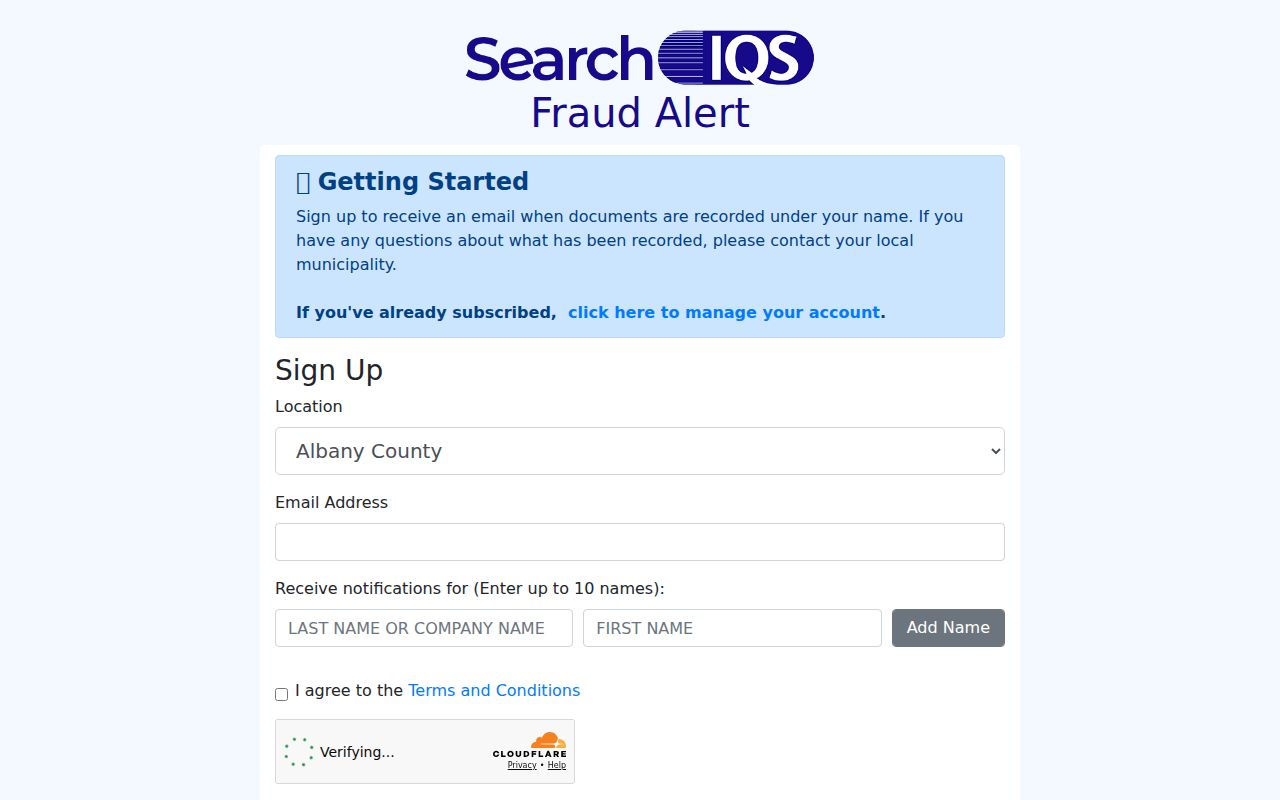
Alerts are not real-time and never block a recording; confirm availability with the Genesee County Clerk.
Limits of Genesee Deed Records
A recorded deed gives public notice and serves as evidence of a transfer. Still, the index alone settles nothing about title, validity, or priority. It may also miss unrecorded interests. A mortgage record does not show a current payoff on its own. Likewise, a lis pendens filing proves only that a lawsuit exists. It does not show how the court ruled.
Recorded is not guaranteed. Use a qualified title professional or attorney for a title opinion and the Clerk for a certified copy.
Copies and Clerk Assistance
An index hit can point you to a transaction. Yet only a copy shows the granting language, reservations, easements, and full legal description. For that, check the Genesee County Clerk fee schedule. Current ordinary and certified-copy terms appear there. So there is no need to rely on an old quoted charge. The Clerk can also tell you which historic volume matches an index citation.
Electronic recording vendors are filing channels for authorized submitters. They do not prove that a consumer search has found every document. Search the official index yourself. Confirm the county, party role, document type, date, and land description. If an image is faint or incomplete, ask the Clerk about the record copy.
Deed-copy solicitations quote public parcel data and charge far more than the official route. Compare any offer with the Clerk's published service before paying. A private seal means nothing official. An urgent tone does not make a letter a county notice.
Finish a Deed Review
Before closing out a deed review, gather the key fields. Match the grantee, grantor, recording date, document type, legal description, municipality, and any prior-instrument citation. Check for later recordings too. A corrective deed or a newer conveyance can change the picture. Keep the instrument number or book and page with the source date. That keeps the Genesee County property records trail documented. When part of the chain rests on an old index book, name that volume. Do not guess at the owner of record. Title questions deserve a professional. If legal rights, priority, or validity are at stake, hand the deed records research to a title professional or attorney. The County Clerk can authenticate a copy and explain access. The public index itself is no opinion that title is clear.